
How to Prepare a Child Travel Consent Letter in Canada: Ontario Guide
A child travel consent letter is a written statement confirming that a child has permission to travel outside Canada from any parent or other person with decision-making responsibility who is not travelling with the child. The Government of Canada recommends carrying one when a child travels internationally without one or both parents or legal guardians, including a short land-border trip to the United States.
A consent letter is not a legal requirement in Canada, but it may be requested by airline staff, immigration authorities in another country, or Canadian officials when the child returns to Canada. A missing or unclear letter can lead to extra questions, delays, or problems at the border. For current federal guidance, see the Government of Canada consent letter page.
Quick answer: If a child under 19 is travelling abroad without all parents or persons with decision-making responsibility, prepare a clear consent letter, include the trip details and contact information, have the non-accompanying person or persons sign it, and carry the original signed document. The Government of Canada strongly recommends having a Notary Public witness the signing.

When is a child travel consent letter recommended?
The Government of Canada recommends a consent letter when a child is travelling:
- alone;
- with only one parent or one person with decision-making responsibility;
- with grandparents, relatives, family friends, or another adult;
- with a school, sports team, music group, religious group, or other organized group;
- with both parents for only part of the trip, if one parent will be absent for another part of the international travel.
This recommendation applies to international travel, including land crossings into the United States, even for a day trip.
What age does this apply to?
The age of majority is not the same in every province, territory, or foreign country. For travel-consent purposes, the Government of Canada says that, to avoid complications, any child under 19 travelling abroad without both parents or all persons with decision-making responsibility should carry a consent letter.
That means an older teenager may still be asked for proof of parental consent even if the teenager can hold an adult passport.
Who should sign the consent letter?
The letter should be signed by each parent or other person who has decision-making responsibility for the child and who is not travelling with the child.
This can include parents who are:
- married;
- in a common-law relationship;
- separated;
- divorced.
If neither parent is travelling, both parents can sign the same consent letter, or each can sign a separate letter. If siblings are travelling together, they may generally be listed on the same letter. If the children will separate during the trip, separate letters are usually more practical.
If obtaining a signature is impossible, unsafe, disputed, or inconsistent with an existing parenting order or agreement, legal advice may be appropriate before travel.
What information should a child travel consent letter include?
There is no single mandatory Canadian format, but a strong letter should make the travel permission easy to understand and easy to verify.
| Section | Information to include |
|---|---|
| Child | Full legal name and enough identifying information to clearly identify the child |
| Non-accompanying parent or decision-maker | Full name, address, telephone number, email if appropriate, and relationship to the child |
| Accompanying adult | Full name, address, contact information, and relationship to the child |
| Travel | Destination country or countries, departure date, return date, and duration of travel |
| Permission | A clear statement that the child is authorized to travel for the stated trip |
| Signature | Signature and date of each non-accompanying person giving consent |
| Witnessing | Witness or notarial details, if the signature is being witnessed |
You may also include practical details such as flight information, accommodation, itinerary, emergency contacts, or passport information where useful. These details can make the purpose and scope of the consent easier to understand, but destination-specific requirements may differ.
A practical 7-step process
1. Confirm who has decision-making responsibility
Before preparing the letter, identify every person who has the legal right to make important decisions for the child.
Do not assume that family status alone answers this question. Separation agreements, parenting plans, court orders, guardianship arrangements, adoption documents, or child welfare arrangements may affect who should provide consent.
2. Check the destination country's rules
A Canadian consent letter may not be enough for every destination. Some countries impose their own entry or exit rules for minors, require specific forms, request translations, or apply additional rules to dual citizens.
Check the destination's current requirements through the Government of Canada Travel Advice and Advisories and, where necessary, the destination country's embassy, high commission, or consulate.
3. Write the permission clearly
The letter should identify:
- the child;
- the person giving permission;
- the adult travelling with the child, if any;
- where the child is going;
- when the child will leave and return;
- the fact that permission is being given for that specific travel.
Avoid vague wording such as “I allow my child to travel whenever needed.” A trip-specific letter is easier for airline and border personnel to understand.
4. Match names to travel documents
Use names consistently with passports, birth certificates, court orders, and other supporting documents. If surnames differ between a parent and child, carry documents that help explain the relationship.
Small spelling differences can create unnecessary questions when travelling.
5. Gather supporting documents
The consent letter may be only one part of the child's travel-document package. Depending on the circumstances, consider carrying:
- the child's passport;
- the child's birth certificate;
- copies of parenting or custody orders and agreements;
- guardianship or adoption documents;
- a death certificate if a parent is deceased;
- the child's visa or immigration documents, where applicable;
- a copy of the travel itinerary;
- contact details for the non-accompanying parent or decision-maker.
The Government of Canada also provides separate guidance on travel documents for children.
6. Arrange witnessing or notarization
The Government of Canada states that any adult may witness the signing, but it strongly recommends that a Notary Public witness the signature. The Canada Border Services Agency also advises travellers to have the consent letter notarized to support its authenticity.
If you are attending a notary appointment for signature witnessing, do not sign the letter in advance unless the Notary Public instructs you otherwise. The purpose of the appointment is usually for the notary to identify the signer and witness the signature being made.
A notary's role in witnessing the signature does not guarantee that an airline, border authority, embassy, or foreign government will accept the letter. Travel requirements remain the responsibility of the traveller.
7. Carry the original signed letter
The Government of Canada recommends travelling with the original signed letter. Photocopies or digital versions may be questioned, and border officials may prefer the original when assessing authenticity.
Keep the consent letter with the child's passport and supporting documents so it can be produced quickly if requested.
Child travelling with one parent
When a child travels with only one parent, the non-accompanying parent should generally sign the consent letter if that person has decision-making responsibility.
The letter should identify the travelling parent, the child, the destination, and the travel dates. The travelling parent should also carry any relevant parenting order or agreement.
Even where one parent has sole decision-making responsibility or an order that permits travel, federal guidance recommends carrying the relevant court documentation and, where possible and safe, a consent letter from the other parent to reduce the risk of delays.
Child travelling with grandparents, relatives, or family friends
If neither parent is travelling, the letter should clearly identify the adult who will accompany the child and explain that person's relationship to the child.
Include reliable contact information for the parents or other persons with decision-making responsibility. Border personnel may want to verify the arrangement.
For longer trips, it can also be useful to carry emergency medical information and any separate authorization that may be required for medical decisions. A travel consent letter itself should not be assumed to create medical decision-making authority.
Child travelling alone or with a group
A child travelling alone should carry a consent letter signed by the appropriate parent or persons with decision-making responsibility.
For school trips, sports teams, camps, music tours, and other group travel, the letter should identify the organization or responsible adult where possible and state the travel period and destination.
Airlines may also have their own unaccompanied minor procedures, age limits, forms, and fees. Check directly with the airline before departure.
Separated or divorced parents
A separation or divorce does not automatically remove the need for a consent letter. The key question is who has decision-making responsibility and what the parenting order or agreement says about travel.
Carry copies of relevant orders or agreements, especially if they address:
- international travel;
- passport possession;
- notice requirements;
- travel restrictions;
- decision-making responsibility.
If the other parent refuses to sign, cannot be located, or if there is a dispute about the child's travel, do not create or sign a substitute consent on that person's behalf. Consider obtaining family-law advice before travelling.
If one parent is deceased
If a parent has died and the surviving parent is travelling with the child, the Government of Canada recommends carrying a copy of the deceased parent's death certificate.
If the child is travelling alone, the child should carry a consent letter signed by the surviving parent together with the death certificate.
If a parent lives outside Canada
A parent living abroad can still sign the consent letter. Federal guidance says the signature can be witnessed abroad, including by an adult or, where available, a consular officer.
Digital signatures may sometimes be accepted, but the Government of Canada recommends carrying the original signed letter to reduce questions about authenticity.
Dual citizens and children who may be considered citizens of another country
A child may be treated as a citizen of another country because of the child's place of birth or a parent's citizenship, even if the family does not normally think of the child as a dual citizen.
That can affect entry, exit, passport, or parental-consent requirements. Check the destination's rules before travel.
Common mistakes to avoid
- Using an old letter for a new trip. Prepare the letter around the actual destination and travel dates.
- Leaving out the return date. A defined travel period helps show the scope of the permission.
- Using nicknames instead of legal names. Match names to passports and supporting documents.
- Signing before a witnessing appointment. If a notary is to witness the signature, wait to sign in the notary's presence.
- Relying only on a phone photo. Carry the original signed document when possible.
- Ignoring a parenting order. Review any order or agreement that affects travel.
- Assuming notarization overrides foreign rules. It does not. Destination authorities can have their own requirements.
- Waiting until the airport. Prepare and review the documents well before departure.
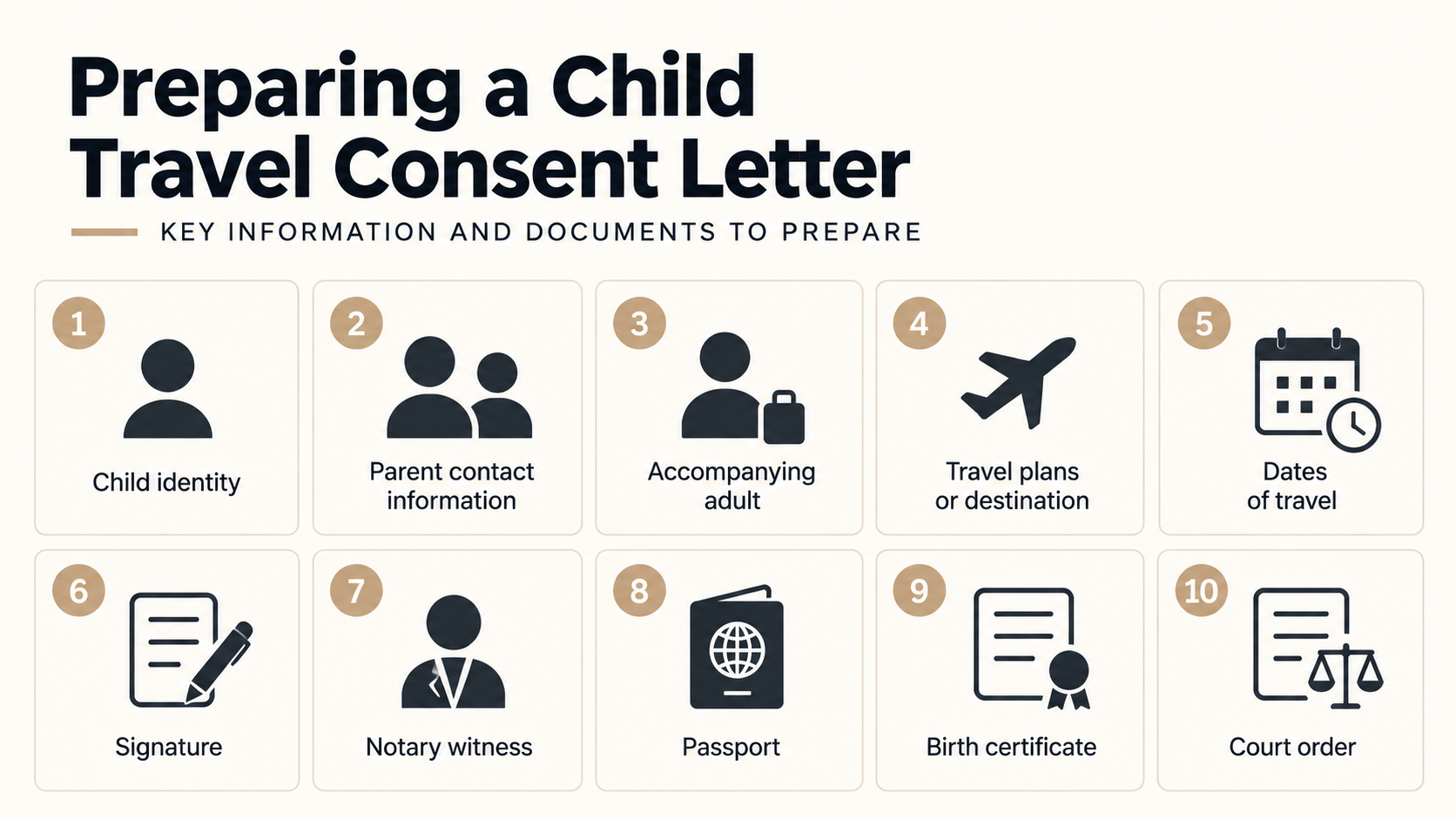
Child travel consent letter checklist
Before the trip, confirm that you have:
- identified every non-accompanying parent or person with decision-making responsibility;
- checked the destination country's rules for minors;
- used the child's full legal name consistently;
- identified the accompanying adult, if any;
- stated the destination and exact travel dates;
- included current contact information for the person giving consent;
- gathered relevant parenting orders or supporting documents;
- arranged signature witnessing or notarization if desired;
- kept the original signed letter with the child's travel documents;
- checked the airline's own requirements.
Frequently asked questions
Is a child travel consent letter mandatory in Canada?
No. The Government of Canada states that a consent letter is not legally required in Canada. However, it is recommended and may be requested by airline staff, foreign immigration authorities, or Canadian officials. Not having one can result in questions, delays, or difficulty entering or leaving a country.
Does a child travel consent letter have to be notarized in Canada?
Notarization is not stated as a universal legal requirement for Canadian travel consent letters. However, the Government of Canada strongly recommends that a Notary Public witness the signing, and the CBSA advises notarization to support the letter's authenticity.
Can I use a photocopy or digital copy?
You may encounter situations where a copy is accepted, but the Government of Canada recommends carrying the original signed letter because photocopies and digital versions may be questioned.
Do I need a letter for a day trip to the United States?
Yes, the federal recommendation applies to crossing an international border, including a land-border day trip to the United States, when the child is not travelling with all parents or persons with decision-making responsibility.
Do teenagers need a consent letter?
They may. To avoid complications, the Government of Canada recommends that any child under 19 travelling abroad without both parents or all persons with decision-making responsibility carry a consent letter.
Can one letter cover more than one child?
Yes. Children from the same family who are travelling together may generally be included in the same letter. If they will travel separately for part of the trip, separate letters are recommended.
What if the other parent will not sign?
If a required or relevant parent refuses to sign, cannot be contacted, or there is a dispute about travel, the appropriate next step may depend on the parenting arrangement and court orders. Consider legal advice rather than altering, replacing, or signing consent on the other person's behalf.
Is the Government of Canada template required?
No. Federal guidance says there is no single official mandatory format, but the Government of Canada provides a useful interactive consent letter template that can be adapted to the family's circumstances.
Final preparation tips
A well-prepared child travel consent letter should be specific, current, easy to verify, and consistent with the child's other travel documents.
Prepare it early, check the destination's rules, carry relevant supporting documents, and keep the original signed letter with the child's passport. If notarization is requested or preferred, arrange the appointment before the travel date and bring appropriate identification.
This article provides general information for families preparing child travel documents in Canada. It is not legal advice and does not replace the requirements of an airline, border authority, court order, embassy, consulate, or foreign government. Requirements can change, so verify them before travel.
ReferencesReview sources
These links are provided as a courtesy so you can review the sources yourself.
1. Government of Canada: Consent letter for children travelling outside Canada 2. Government of Canada: Recommended consent letter template for children travelling abroad 3. Canada Border Services Agency: Travel and identification documents for entering Canada 4. Government of Canada: Travel documents for children 5. Government of Canada: Travel Advice and Advisories 6. Department of Justice Canada: Parenting Plan Tool