
Why a signature can matter as much as the document itself
A signature may look simple, but legally and practically it can perform several important functions. It may identify the person agreeing to a contract, confirm consent, adopt the contents of a declaration, authorize another person to act, or show that a document was formally executed.
The difficulty is that a signature by itself does not always answer an important question: who actually signed it, and under what circumstances?
That is where signature witnessing and notarization can become important.
In Ontario, a notary public has statutory authority to witness or certify and attest the execution of a document, certify and attest a true copy of a document, and exercise the powers of a commissioner for taking affidavits. These powers come from Ontario's Notaries Act and are explained by the province on its information page for notaries public.
Not every document must be notarized. Notarization is required only when the applicable law, document, receiving organization, foreign authority, government agency, or transaction requires it. In other situations, it may simply provide a stronger formal record of how a document was signed.

What does signature witnessing mean?
At its simplest, signature witnessing means that another person observes a person sign a document and can attest that the signing occurred.
When an Ontario notary public witnesses and attests the execution of a document under the Notaries Act, the notary is acting in an official capacity rather than merely as a friend, colleague, or casual witness.
The exact procedure depends on the document and its intended use. The notary may need to confirm the signer's identity, determine what type of notarial act is requested, observe the signing, complete an appropriate notarial certificate, and apply the notary's signature and seal.
A witnessed signature can therefore create an additional layer of evidence about the document's execution.
A notary's role is not simply to put a stamp on paper. The important part is the official act that the signature, seal, and certificate record.
What is notarization in Ontario?
The word notarization is often used broadly, but different notarial services do different things.
Ontario's Notaries Act provides that a notary public may:
- witness or certify, and attest, the execution of a document
- certify and attest a true copy of a document
- exercise the powers of a commissioner for taking affidavits
- perform other functions authorized by law
The Law Society of Ontario's guidance on notaries public similarly explains that Ontario notarization is governed by the Notaries Act.
The service you need therefore depends on what must be proven or formally confirmed.
Signature witnessing, commissioning, and certified copies are not the same thing
These terms are frequently used as though they are interchangeable. They are not.
| Service | What it generally addresses | Typical purpose |
|---|---|---|
| Signature witnessing / attestation of execution | The execution or signing of a document | To provide formal evidence that a particular person executed the document |
| Commissioning an affidavit | A written statement sworn or affirmed to be true | Court, administrative, immigration, financial, or other evidentiary purposes |
| Taking a statutory declaration | A solemn declaration made before an authorized person | To formally declare facts when a declaration is required or accepted |
| Certified true copy | Comparison of a copy with the original document | To provide a certified copy when the original should not or cannot be submitted |
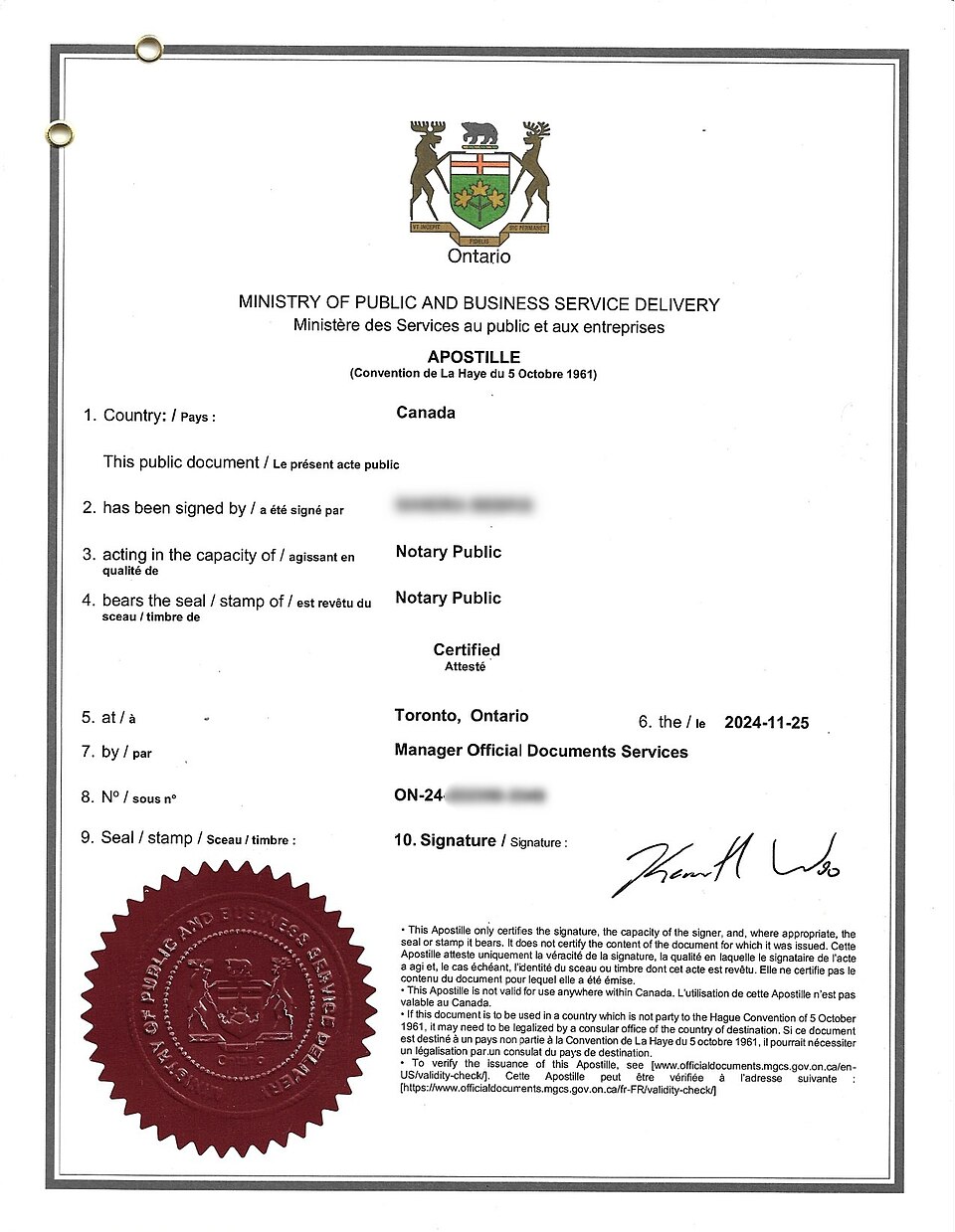
| Apostille or authentication | Authentication by a government competent authority of the relevant public signature, capacity, seal, or stamp | Use of eligible public documents outside Canada |
This distinction is important because a commissioner for taking affidavits does not automatically have all of the powers of a notary public. Ontario specifically explains the difference on its notary information page and its page about commissioners and notaries.
Why is signature witnessing important?
There is no single reason. Different documents use witnessing for different purposes.
1. It helps connect the signature to the signer
A document may travel far from the person who signed it. It may later be reviewed by a bank, court, government department, university, foreign authority, business, lawyer, or another institution.
The recipient was usually not present when the document was signed.
A formal witnessing process can provide evidence that an identified individual personally executed the document before the witness or notary.
This is particularly important where a signature carries significant legal, financial, personal, or international consequences.
2. It can reduce uncertainty about authenticity
An unsigned document may be incomplete. A signed document may still raise questions if the recipient cannot determine who signed it or whether the signature is genuine.
Formal witnessing does not eliminate fraud, forgery, impersonation, coercion, or future disputes. It can, however, create an independent record of the signing process and make casual impersonation more difficult.
For affidavits and declarations, Ontario law goes further. Under the Commissioners for Taking Affidavits Act, the person administering the oath or declaration must satisfy themselves of the genuineness of the deponent's or declarant's signature and must properly administer the oath or declaration before signing the jurat or declaration.
3. It can establish that required formalities were followed
Some documents are effective only if certain execution requirements are satisfied.
The formalities vary considerably. A particular document might require:
- one witness
- two witnesses
- a commissioner for taking affidavits
- a notary public
- an oath or affirmation
- a statutory declaration
- notarization before authentication
- a specific certificate or wording
It is therefore unsafe to assume that every witness can perform every function or that every document needs a notary.
4. It may help a receiving institution rely on the document
An organization receiving a document may have no practical way to investigate the signing circumstances itself. A recognized notarial certificate, signature, and seal can provide an established formal method for recording execution.
This is one reason notarization is frequently encountered in cross-border transactions, foreign powers of attorney, declarations, corporate documents, consent letters, certified copies, and documents submitted to foreign institutions.
5. It creates accountability around sworn statements
Affidavits and statutory declarations are more than ordinary signed statements.
Ontario's guide for commissioners for taking affidavits explains that an affidavit is a written statement confirmed to be true by oath or affirmation. The Canada Evidence Act provides a statutory form for solemn declarations.
Knowingly making a false statement under oath or solemn affirmation can have serious consequences. Section 131 of the Criminal Code addresses perjury where the statutory elements of that offence are met.
What does a notary normally confirm when witnessing a signature?
The exact procedure depends on the requested act, but a careful notarial appointment commonly focuses on several questions.
Identity
The notary must be able to connect the person appearing for the appointment with the person whose signature is being notarized.
For affidavits and declarations, Ontario's official commissioner guide specifically requires the deponent or declarant to provide proof of identity when signing in person.
Depending on the circumstances and the notary's procedures, clients may be asked to provide valid government-issued photo identification and additional identification where appropriate.
Personal appearance
For a traditional in-person signature witnessing, the signer appears before the notary and signs as required for that notarial act.
This matters because a notary cannot truthfully certify that they witnessed an event they did not witness.
The requested notarial act
The notary needs to know what the recipient actually requires.
For example, the recipient may be asking for:
- a witnessed signature
- a notarized declaration
- an affidavit
- a certified true copy
- a notarized copy for authentication
- a notarized signature for use abroad
These are different services.
The document's intended destination
A document intended for use in Ontario may have different requirements from a document intended for use in Italy, Ukraine, Poland, the United States, the United Arab Emirates, or another jurisdiction.
For foreign use, the destination country and receiving authority are particularly important because notarization may be only one stage in a larger process.
What notarization does not prove
This is one of the most important parts of understanding notarial services.
Notarization does not automatically prove that every statement is true
A notary witnessing a signature is not ordinarily investigating every factual statement contained in the document.
Similarly, Ontario's Official Documents Services explains that when it authenticates a document, it checks the relevant signatures and seals or stamps against its records, but does not validate the document's contents. See Ontario's document authentication guidance.
Notarization does not automatically make a document legally valid
A notarized document can still have legal defects.
For example, a document might:
- use the wrong form
- contain prohibited terms
- fail to satisfy statutory requirements
- require additional witnesses
- have been signed by a person without the necessary authority
- require registration, filing, authentication, or another procedural step
- be unacceptable to the intended recipient
A notarial seal does not cure those problems by itself.
Notarization is not automatically legal advice
A person may attend a notary appointment only for a notarial service. That does not necessarily mean the notary has been retained to advise on the legal consequences of the document.
The Law Society of Ontario and the Ministry of the Attorney General both distinguish the performance of notarial or commissioning functions from the provision of legal advice.
Notarization does not guarantee acceptance
The receiving institution ultimately determines whether a document satisfies its requirements.
This is especially important for foreign governments, consulates, universities, financial institutions, courts, immigration authorities, and other organizations that may impose their own document standards.
Before notarization, confirm what the receiving organization actually requires. A request for a "notarized document" may mean a witnessed signature, a certified copy, a sworn declaration, or a document that must later receive an apostille or authentication.
Do all important documents need notarization?
No.
The importance of a document does not by itself determine whether notarization is required.
Ontario law provides useful examples.
Powers of attorney
Under Ontario's Substitute Decisions Act, 1992, a continuing power of attorney for property and a power of attorney for personal care generally have their own statutory witnessing requirements. The Act requires execution in the presence of two witnesses and specifies persons who cannot act as witnesses.
That does not mean every Ontario power of attorney must be notarized by a notary public.
The correct execution requirements must be determined from the applicable legislation and the intended use of the document. A foreign power of attorney, or an Ontario-signed document intended for use in another country, may have very different requirements.
Ontario also provides public information on making a power of attorney.
Wills
Ontario wills are governed by the Succession Law Reform Act, which contains its own rules concerning execution and witnesses.
Notarization is not a substitute for complying with the statutory requirements governing wills.
Electronic signatures
Ontario's Electronic Commerce Act, 2000 recognizes electronic signatures for many purposes, subject to the legislation and document-specific requirements.
An electronic signature and notarization are separate concepts. The fact that a document may be electronically signed does not automatically mean that an Ontario notarization may be completed remotely.
Can notarization be done online in Ontario?
This requires an important distinction between remote commissioning and remote notarization.
Remote commissioning can be permitted
Ontario Regulation 431/20, Administering Oath or Declaration Remotely, permits an oath or declaration to be administered remotely when the regulatory requirements are met.
Among other things, participants must be able to see, hear, and communicate with one another in real time throughout the transaction, the person's identity must be confirmed, a modified jurat or declaration must be used, reasonable precautions must be taken, and a record of the transaction must be kept.
Ontario's commissioner guide provides additional practical guidance.
Remote notarization is different
As of 2026, Ontario states that notaries cannot notarize documents remotely because the required regulation permitting remote exercise of notarial powers has not been made. The Law Society of Ontario likewise states in its notary public guidance that remote or virtual notarization is not currently permitted in Ontario.
The Law Society also issued a notice concerning online notary services addressing this issue.
This distinction is essential. A document that can be commissioned remotely is not necessarily a document that can be notarized remotely.
Affidavits are a good example of why witnessing matters
Affidavits are commonly used in Ontario court proceedings and administrative processes.
The Ontario Rules of Civil Procedure require an affidavit used in a civil proceeding to be signed by the deponent and sworn or affirmed in accordance with the Commissioners for Taking Affidavits Act.
The Ontario Superior Court's guide to civil cases similarly explains that a person signing an affidavit must swear or affirm it before a commissioner or notary.
Ontario family court procedures contain many similar examples. The province's guidance on starting a family case, serving documents, and bringing a motion identifies forms that must be sworn or affirmed before a commissioner for taking affidavits.
The signature in these situations is therefore part of a formal evidentiary process, not simply a decorative line at the bottom of a form.
Signature witnessing is used far beyond court documents
Notarial and commissioning services appear in many areas of ordinary life.
Immigration and citizenship documents
Immigration, Refugees and Citizenship Canada sometimes requires affidavits from translators or certified copies in particular application processes.
IRCC's citizenship certificate application guide, for example, describes situations in which a translator's affidavit may be sworn before a notary public, commissioner of oaths, or commissioner for taking affidavits in Canada.
IRCC also explains certified photocopies and affidavits in its guidance for open work permits for vulnerable workers.
The exact immigration requirements depend on the application and the current IRCC instructions.
Service Canada documents
Service Canada's Social Insurance Number document requirements explain that where a non-certified translator is used in the circumstances described by the program, the translator may need an affidavit sworn before an authorized person, such as a notary public or commissioner in Canada.
OSAP affidavits
Ontario's OSAP definitions explain that an affidavit is a document whose contents have been sworn to be true and may be signed before a lawyer, commissioner of oaths, or notary public.
Child travel consent letters
The Government of Canada recommends that children travelling abroad without one or both parents or persons with decision-making responsibility carry an appropriate consent letter.
Canada's recommended consent-letter guidance states that a consent letter is not legally required in Canada but may be requested by immigration authorities, airlines, or Canadian officials. The guidance states that any adult may witness the signing, while strongly recommending that a notary public witness it.
This is an excellent example of why the answer to "Do I need notarization?" is sometimes more nuanced than yes or no.

Why notarization matters even more for documents going abroad
A domestic recipient may already be familiar with Ontario documents and authorities. A foreign recipient may not be.
That creates an additional verification problem.
The foreign organization may need to know whether the Ontario notary's signature and seal are genuine. Depending on the country and document, this may lead to an apostille or authentication process.
Ontario's Official Documents Services is the provincial authority responsible for issuing apostilles and certificates of authentication for eligible Ontario documents.
ODS explains that it verifies documents by comparing relevant signatures and seals or stamps with information in its records. Notarized documents issued by an Ontario notary public can continue to be eligible for authentication, subject to the applicable requirements.
Global Affairs Canada similarly explains in its authentication guidance that Canadian documents may need authentication or an apostille for use abroad.
Its authentication requirements explain that some documents must be notarized before authentication and set out requirements relating to recognized notarial signatures and seals.
What an apostille actually authenticates
The HCCH Apostille Convention provides that an apostille certifies the authenticity of the relevant signature, the capacity in which the signer acted, and, where appropriate, the identity of the seal or stamp.
It does not turn every statement in the underlying document into a government-certified fact.
This distinction is fundamental:
- The signer signs the underlying document.
- The notary performs the required notarial act.
- The competent authority may authenticate or apostille the relevant public signature, capacity, seal, or stamp.
- The receiving authority decides whether the completed document satisfies its requirements.
A commissioner and a notary are not interchangeable
This distinction frequently causes problems.
A commissioner for taking affidavits is authorized to administer oaths and take affidavits, declarations, and affirmations within the scope of that person's authority.
A notary public has those commissioning powers plus the notarial powers granted by the Notaries Act, including the power to witness or certify and attest execution and to certify true copies.
Ontario expressly notes that documents that have only been commissioned by a commissioner for taking affidavits are not processed by ODS for apostille as notarized documents. See Ontario's information for notaries and authentication guidance.
If your document is going abroad, choosing the correct service at the beginning can prevent unnecessary delays.
Should you sign the document before seeing the notary?
If the purpose of the appointment is to have the notary witness your signature, the safest practice is generally not to sign in advance unless you have confirmed that this is acceptable for the specific notarial act.
For an affidavit or declaration that must be sworn, affirmed, or declared before the authorized person, Ontario's commissioner guidance explains that the document is signed as part of the formal process.
If you already signed the document, tell the notary before the appointment. Whether the document can still be properly completed depends on what the receiving organization requires and what act the notary is being asked to perform.
Why identification is important
A notarial certificate becomes much less useful if the identity of the signer is uncertain.
Identity verification helps address the possibility that one person is attempting to sign in another person's name.
Ontario's remote commissioning regulation expressly requires confirmation of the deponent's or declarant's identity, and the provincial commissioner guide requires proof of identity for in-person affidavits and declarations.
Identity procedures may vary depending on the service, document, risk, and professional requirements. A client should therefore be prepared to present valid identification acceptable to the notary.
Does the notary read the document?
A notary may need to review enough of the document to determine the requested act, identify the signature page, confirm the document's basic structure, complete the certificate properly, and identify any obvious issue that prevents the requested notarial act from being completed.
That is different from providing a legal opinion on the entire document.
If you need advice about whether you should sign a contract, power of attorney, settlement, waiver, guarantee, transfer, or other legal instrument, you may require legal advice rather than only notarization.
Does notarization mean the signer understood everything?
Not automatically.
Notarial and commissioning procedures can include reasonable steps to ensure that the person understands the nature of the act being performed. Ontario's remote commissioning regulation, for example, requires reasonable precautions, including ensuring that the deponent or declarant understands what is being signed.
But notarization is not a substitute for independent legal advice, interpretation, translation, capacity assessment, or substantive review when one of those services is required.
If the signer does not understand the language of the document, that issue should be raised before signing.
What should you bring to a signature-witnessing appointment?
Requirements vary, but a practical preparation list usually includes:
- The complete document. Bring all pages, not only the signature page, unless the recipient has instructed otherwise.
- Valid identification. Bring current government-issued identification acceptable for the service.
- Instructions from the receiving organization. If an embassy, university, bank, foreign lawyer, government agency, or other organization provided written requirements, bring them.
- The destination country. This is essential when the document will be used outside Canada.
- Any required originals. A certified true copy generally requires comparison with the original document.
- Supporting documents. Depending on the transaction, these may include court orders, corporate authority documents, translations, or related records.
- Do not pre-sign when witnessing is required. Confirm the signing procedure before your appointment.
Common mistakes that can delay a notarization
Many document problems are preventable.
Signing too early
If the notary must witness the signature, signing before the appointment can create a problem.
Bringing only the signature page
A notary may need to see the complete document to understand what is being executed and to determine whether the certificate can properly be completed.
Asking for the wrong service
A "notarized copy," "notarized signature," affidavit, statutory declaration, and certified true copy are not the same thing.
Assuming a foreign document follows Ontario rules
A document drafted for use abroad may contain its own signature, witness, seal, translation, apostille, consular, or legalization requirements.
Assuming notarization automatically includes an apostille
It does not. The notary performs the notarial act. The appropriate government competent authority issues the apostille or authentication certificate.
Assuming every important document must be notarized
Some important Ontario documents have their own witness requirements without requiring a notary. Always determine the actual rule that applies.
When should you confirm requirements before booking?
You should obtain clarification from the receiving organization when:
- the instructions simply say "notarize this" without explaining what must be notarized
- the document will be used outside Canada
- the document contains a foreign notarial certificate
- the organization requires an apostille
- you are unsure whether an original or certified copy is required
- the document is already signed
- more than one person must sign
- witnesses with particular qualifications are required
- the document is in a language the signer does not understand
- remote signing is being requested
The Law Society of Ontario's notary guidance specifically recommends that notaries ascertain the purpose of the notarization and confirm the specific requirements for the document.
The real purpose of signature witnessing
Signature witnessing is ultimately about reliability of execution.
Documents often outlive the moment when they are signed. Months or years later, someone may need to determine whether the document can be trusted as an authentic record of an act performed by a particular person.
A formal witness or notary cannot guarantee everything about the transaction. But the witnessing process can create an independent, structured record connecting:
- the signer
- the signature
- the document
- the date of execution
- the witnessing authority
- the notarial certificate or jurat, where applicable
That structure is why witnessing has remained important even in an age of electronic documents and digital communication.
A simple way to think about it
Ask what the recipient needs to know.
If the recipient needs confidence that you personally signed the document, signature witnessing may be required.
If the recipient needs you to swear or affirm that statements are true, you may need an affidavit.
If you need to solemnly declare facts, you may need a statutory declaration.
If the recipient needs confirmation that a photocopy matches an original, you may need a certified true copy.
If the document must be recognized outside Canada, you may also need an apostille or authentication.
The correct service depends on the purpose of the document, not simply on the word "notary."
Practical note: Notarization requirements depend on the document, the applicable law, the receiving organization, and the jurisdiction where the document will be used. Confirm the recipient's requirements before signing. Notarization does not by itself confirm the truth of every statement, guarantee legal validity, or guarantee acceptance. This article provides general information and is not legal advice.
ReferencesReview sources
These links are provided as a courtesy so you can review the sources yourself.
- Ontario Ministry of the Attorney General: Information for notaries public in Ontario
- Ontario Notaries Act
- Ontario Commissioners for Taking Affidavits Act
- Ontario: Guide for newly appointed commissioners for taking affidavits
- Ontario Regulation 431/20: Administering Oath or Declaration Remotely
- Ontario: Becoming a commissioner for taking affidavits or a notary public
- Ontario: Find a notary public or commissioner of oaths for taking affidavits
- Law Society of Ontario: Notary public
- Law Society of Ontario: Commissioner for taking affidavits
- Law Society of Ontario: Notice to the Professions on online notary services
- Ontario: Authenticate a document for use outside Canada
- Global Affairs Canada: Authentication of documents
- Global Affairs Canada: Authentication requirements
- HCCH: Convention of 5 October 1961 Abolishing the Requirement of Legalisation for Foreign Public Documents
- Canada Evidence Act, section 41
- Criminal Code, section 131
- Ontario Rules of Civil Procedure
- Ontario Superior Court of Justice: Steps to a civil case
- Ontario: Starting your family case
- Ontario: Serving your family court documents
- Ontario: Steps to bringing a motion in family court
- Ontario Substitute Decisions Act, 1992
- Ontario: Make a power of attorney
- Ontario Succession Law Reform Act
- Ontario Electronic Commerce Act, 2000
- Ontario: OSAP definitions, affidavit
- Government of Canada: Recommended consent letter for children travelling abroad
- IRCC: Guide for citizenship certificate applications
- IRCC: Open work permit for vulnerable workers, affidavits and certified photocopies
- Service Canada: Social Insurance Number required documents